


Federal A.I. Policy and Broadband Funding Are Converging
President Donald Trump signed an executive order this week aimed at limiting state-level regulation of artificial intelligence, directing the federal government to pursue a single national framework for A.I. governance.
Beyond technology policy, the order carries potential implications for broadband funding. It signals that states maintaining certain A.I. laws could face federal enforcement action or see discretionary funding — including broadband-related grants — placed at risk.
Executive Order Expands Federal Enforcement Authority
The order grants the U.S. attorney general broad authority to challenge state A.I. laws that the administration views as conflicting with federal priorities. Federal agencies are also directed to review existing state regulations and identify laws that could be subject to enforcement or legal action.
The administration has argued that state-by-state A.I. regulation creates uncertainty for infrastructure investment and slows deployment of technologies that support economic growth.
Broadband and BEAD Funding Implications
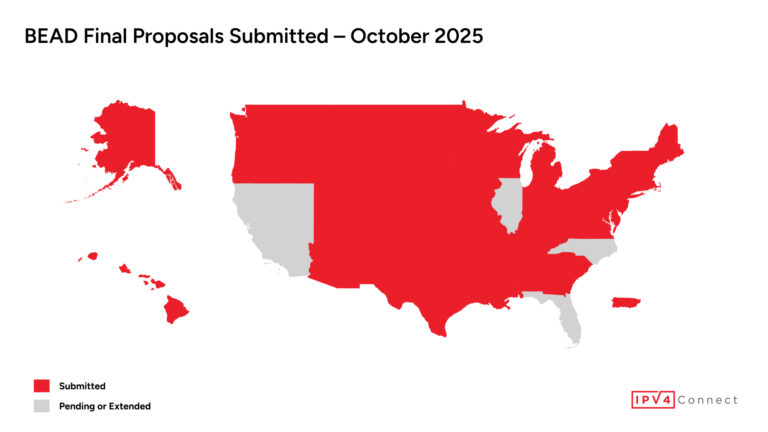
The executive order arrives as states continue to rely heavily on federal broadband programs, including the $42.45 billion Broadband Equity, Access, and Deployment (BEAD) program. By linking compliance with national A.I. policy priorities to federal funding, the order introduces a new variable into broadband planning and grant administration.
For state broadband offices, network operators, and infrastructure investors, the development raises questions about how A.I. governance could influence eligibility, timelines, and oversight for broadband projects.
States Previously Filled a Federal Regulatory Gap
In the absence of comprehensive federal A.I. legislation, states have enacted their own laws addressing issues such as consumer protection, deepfake content, transparency requirements, and election integrity. According to the National Conference of State Legislatures, all 50 states and U.S. territories introduced A.I. legislation in 2025, with 38 states adopting roughly 100 measures.
Legal and Policy Uncertainty Ahead
The executive order is expected to face legal challenges, with critics arguing that Congress, not the executive branch, has primary authority to pre-empt state law. Regardless of the outcome, the order marks a significant escalation in federal involvement in A.I. governance and its intersection with broadband and infrastructure funding.
For the broadband sector, the move shows how emerging technology policy decisions may increasingly shape funding conditions and regulatory risk beyond traditional telecommunications frameworks.