



Fiber Absorbs the Majority of BEAD
The early distribution of BEAD funding continues to reveal a highly asymmetric landscape: while satellite operators qualify under the program’s technology-neutral rules, they are capturing only a small share of awards. New Street Research’s latest modeling—released December 5—estimates that satellite broadband providers will receive just 4% of the roughly $20 billion allocated so far, with fiber networks claiming the overwhelming majority.
For observers tracking how federal funding will shape U.S. network infrastructure over the next decade, the trend is becoming increasingly clear: BEAD is steering states toward long-lived, capital-intensive fiber deployments, even in areas where alternative technologies could play a meaningful role.
Modeling Shows a Strong Policy Pull Toward Fiber
New Street Research analysts Bruno Marin and Vikash Harlalka project that BEAD’s total funding disbursement will ultimately reach $42.45 billion. Yet the early numbers signal a decisive tilt:
- SpaceX Starlink is expected to secure approximately $1.24 billion over the life of the program.
- Amazon Project Kuiper and smaller satellite operators together are estimated to receive around $300 million.
- Fiber providers, meanwhile, account for about 86% of funds allocated so far—amounting to billions flowing to national ISPs and regional fiber cooperatives.
The data suggests that, although the BEAD framework was designed to be open to multiple access technologies, the regulatory interpretation of “reliability” makes fiber the default in most state-level scoring systems.

California’s Proposal Highlights a Broader National Pattern
California—the final state to publish a BEAD draft plan—offers a telling example of how states are applying NTIA guidance.
The California Public Utilities Commission released its $1.86 billion draft proposal on December 2. The public comment window runs through December 9, but the initial framework already shows how satellite systems are positioned relative to terrestrial networks.
California’s provisional awards include:
- Amazon Project Kuiper receiving $101 million to reach roughly 92,000 locations
- SpaceX Starlink receiving $63 million to serve about 46,000 locations
- Fiber providers, including AT&T with over $331 million and GeoLinks with nearly $180 million
What stands out is not just the scale of fiber awards—consistent with national trends—but the decision to allocate more than twice as many locations to Project Kuiper, a constellation that is not yet commercially active, compared to Starlink, which already operates a global LEO network.
For infrastructure analysts, this raises key questions about how states are evaluating readiness, scalability, and operational proof when comparing satellite and terrestrial systems.
The NTIA’s Standard for “Reliable Broadband” Drives Much of the Outcome
While BEAD’s legislation emphasizes inclusivity among technologies, the NTIA’s working definition of “reliable broadband” places fiber in the strongest position. Regulators have consistently framed fiber as the most durable, upgrade-friendly, and predictable option for rural deployment.
In remarks on December 2, NTIA officials noted that any unused or “leftover” funding could be recaptured, but reinforced that fiber remains the preferred long-term investment for public dollars. LEO systems, while fast and increasingly capable, are still viewed by regulators as complementary rather than foundational.
The result is a funding structure where:
- Fiber scores highest by default,
- Satellite systems are often used only where fiber construction is impractical, and
- States applying competitive scoring rubrics inevitably push most awards to wired infrastructure.
What Happens Next
California’s plan remains in draft form until December 9, 2025, when the comment period ends. After the CPUC finalizes its proposal, the state will submit it to NTIA for certification.
If early distribution patterns continue, satellite broadband will remain a small component of BEAD deployment—despite growing performance, declining latency, and the increasing role of satellite backhaul in rural and edge networks.
For the broadband ecosystem, the implications are significant. The decisions made in this first wave of BEAD allocations will shape Middle Mile and Last Mile infrastructure footprints for decades, influencing everything from local ISP economics to national addressability, IP provisioning, and long-term network planning.
More on BEAD and Broadband
- More of our recent stories about BEAD and public broadband programs
- For up-to-date information on the $42 billion BEAD Program, check Brander Group’s BEAD funding progress dashboard
- California Begins BEAD Funding Applications for ISPs
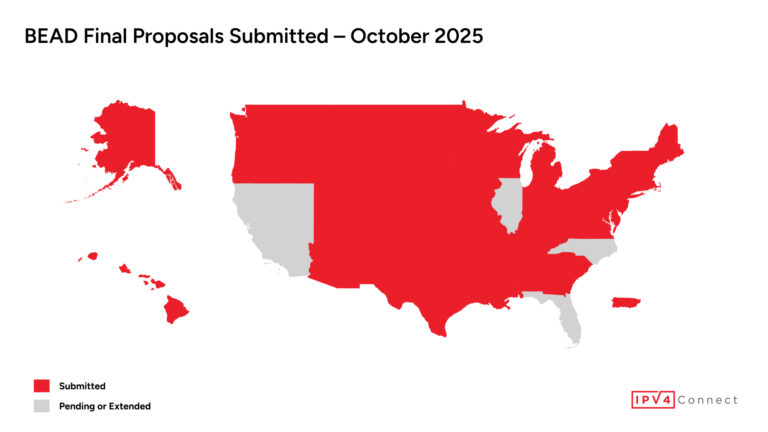
- States Submit Final BEAD Proposals to NTIA




Leave a Reply